E7386 (Licensing Partner : Eisai)
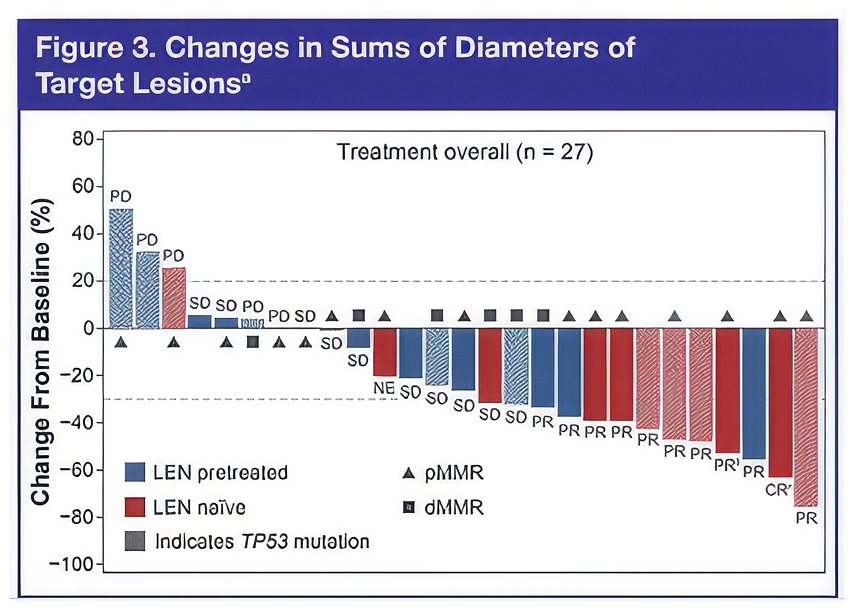
In a late Phase Ib/Phase II clinical study of E7386 in combination with LENVIMA® (lenvatinib), Eisai’s orally available tyrosine kinase inhibitor, for the treatment of solid tumors, data presented at the European Society for Medical Oncology (ESMO) Congress in October 2025 (data cutoff: June 4, 2025) demonstrated responses in 11 patients, resulting in an objective response rate (ORR) of 36.7%. Notably, the ORR reached 57.1% among patients who had not previously received LENVIMA®.
In addition, at the American Association for Cancer Research (AACR) Annual Meeting held in April 2026, Eisai presented new nonclinical data on the combination of E7386 and LENVIMA®. The findings suggested that E7386 may enhance the antitumor activity of LENVIMA® in the treatment of endometrial cancer.
Eisai is currently enrolling patients in the dose-optimization portion of the study (Phase II) and has announced its plan to obtain topline data during fiscal year 2026 (by March 2027).
The company is aiming to obtain regulatory approval by March 2031 for the treatment of endometrial cancer with the E7386 and LENVIMA® combination.
CBP/β-Catenin Interaction Inhibitors
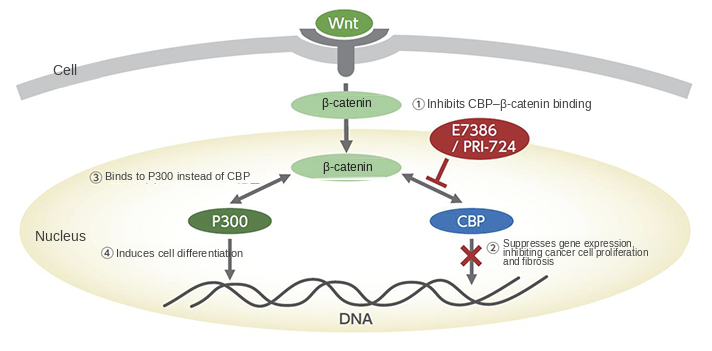
The Wnt signaling pathway is a network of a wide range of biological processes, including cancer progression and fibrosis, and has long been recognized as an attractive target for drug discovery. Because Wnt signaling plays essential roles not only in pathological processes such as tumorigenesis and fibrosis but also in normal cellular differentiation and tissue homeostasis, complete inhibition of the pathway can lead to significant adverse effects. Conventional Wnt inhibitors have generally targeted upstream components of the pathway, resulting in broad suppression of Wnt signaling and unacceptable toxicity, which has limited their clinical development.
E7386 and PRI-724 were designed based on a novel concept aimed at achieving therapeutic efficacy while maintaining an acceptable safety window. ctivation of Wnt signaling requires the binding of β-catenin to the transcriptional coactivator CREB-binding protein (CBP) in the cell nucleus. PepMetics® compounds selectively bind to CBP and inhibit its interaction with β-catenin. Importantly, these compounds do not bind to p300, a closely related protein with functions similar to those of CBP. As a result, β-catenin/p300-mediated signaling remains intact while CBP/β-catenin signaling is selectively inhibited. This selective mechanism enables PepMetics® compounds to suppress pathological processes such as cancer progression and fibrosis without completely shutting down the overall Wnt signaling pathway.

Eisai Co., Ltd.
- Eligible to receive more than ¥25 billion in upfront payments, development and sales milestone payments, and research funding.
- License agreement for the target product.
- E7386, an orally available CBP/β-catenin interaction inhibitor jointly discovered by PRISM BioLab and Eisai, achieved clinical proof of concept (POC) in November 2021.
- In a late Phase Ib/Phase II trial evaluating E7386 in combination with LENVIMA® (lenvatinib), interim data presented by Eisai at ESMO 2025 demonstrated promising preliminary antitumor activity and a high objective response rate (ORR) in patients with endometrial cancer.
- The combination showed a manageable safety profile and achieved an ORR of 36.7%, while patients with no prior LENVIMA® treatment achieved an ORR of 57.1%.
- Eisai is advancing the Phase II dose-optimization study in endometrial cancer and aims to obtain regulatory approval by March 2031 for the E7386 and LENVIMA® combination