PepMetics®: A Small-Molecule Platform for Flexible Peptide Mimicry
Small mMolecules that act like peptides.
PepMetics® compounds retain peptide-like functionality while enabling the synthetic flexibility and oral bioavailability of small molecules. In nature, peptides—classified as mid-sized molecules—often exhibit high selectivity and affinity toward protein–protein interactions (PPIs), and peptide- based therapeutics have been successfully developed. However, most peptide drugs are delivered by injection limiting their use, hence the need for oral alternatives. Although numerous oral drugs have been created from small molecules through diverse synthetic methodologies, controlling PPIs with conventional small molecules has remained challenging.
PepMetics® technology, developed by PRISM BioLab, is a peptide-mimetic approach that reproduces protein secondary structures such as α-helices and β-turns. By flexibly introducing substituents derived from natural and non-natural amino acids onto small- molecule scaffolds, PepMetics® combines advantages of both natural molecular recognition and synthetic chemistry. This enables modulation of PPIs in both intracellular and extracellular environments.
Three-Dimensional Mimicry of Protein Secondary Structures
PepMetics® compounds adopt stable conformations that mimic naturally occurring α-helices and β-turns. Each compound consists of a robust, three-dimensional scaffold incorporating multiple saturated ring structures, onto which diverse side chains are attached. More than 40 distinct scaffolds have been synthesized to date, with side chains freely expandable through chemical synthesis.
By controlling the stereochemistry of multiple chiral centers within the scaffold, side chains can be precisely positioned in three-dimensional space, enabling rich structural diversity.
Unlike peptides, which often fail to maintain short α-helical or β-turn conformations, PepMetics® compounds stably preserve these structures. This conformational stabilization reduces entropic penalties upon binding and significantly enhance binding affinity.
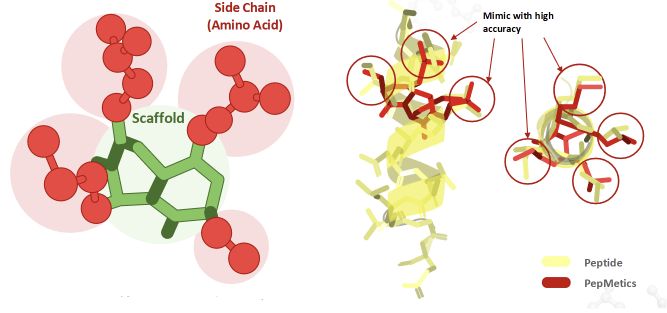
Overview of PepMetics® Compounds
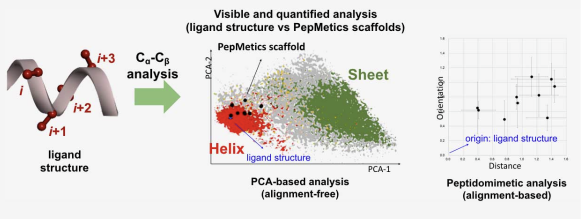
Reference: ACS Omega, 2021, 6, 26601.
Application to Drug Discovery Based on Amino Acid Sequence Information
PepMetics® technology enables the design of small-molecule mimetics even for bioactive peptides whose three-dimensional structures are unknown. While many peptide binders that recognize specific proteins have been reported, structure-based drug discovery is often difficult due to limited structural information.
Using amino acid sequence and secondary structure information, PepMetics® compounds can be designed to mimic peptide binders. For example, cyclic peptides are often replaced by PepMetics® compounds by mimicking 3–4 consecutive amino acids that adopt α-helical or β-turn-like conformations. Through an integrated workflow—activity evaluation, in silico docking, pharmacophore extraction, and virtual screening—hit identification and lead expansion can be efficiently achieved.
- Consecutive sequences of 3–4 amino acids are shifted one position at a time, and PepMetics® compounds mimicking portions of the cyclic peptide sequence are synthesized.
- The activity of PepMetics® compounds is evaluated to identify hit compounds.
- The binding mode of hit compounds is predicted through in silico docking simulations, informing structure–activity relationships (SAR).
- Key binding features (pharmacophores) are extracted from the computationally predicted binding modes.
- Based on these pharmacophores, virtual screening is performed to select and synthesize promising compounds
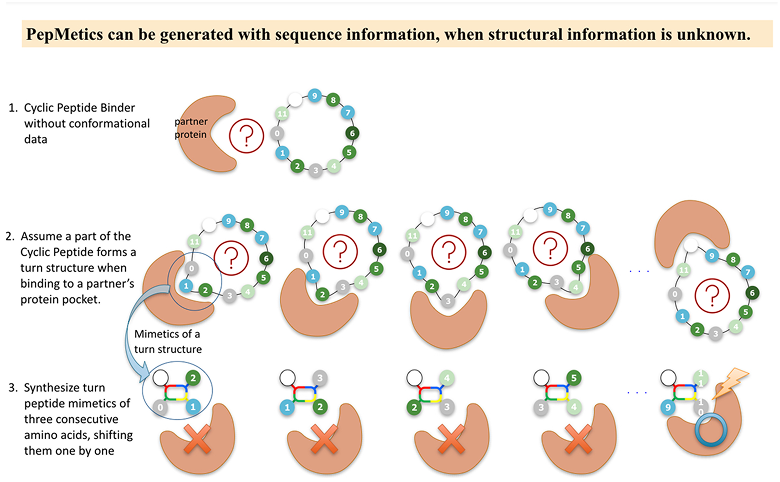
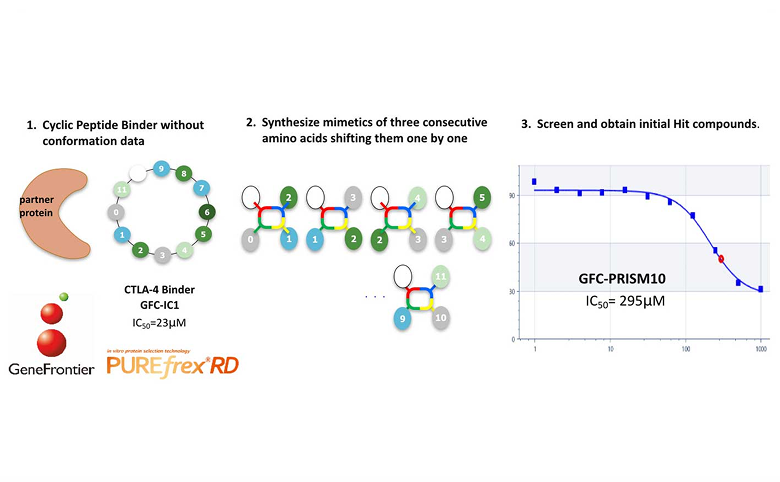
Reference: Pharmaceuticals, 2022, 1506.
Application to Drug Discovery Targeting Intrinsically Disordered Proteins (IDPs)
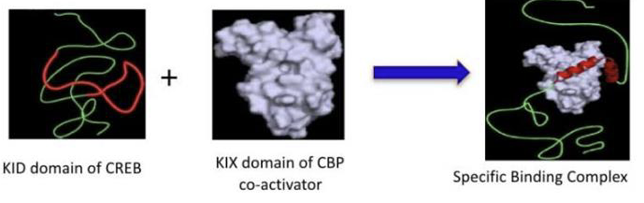
Intrinsically disordered proteins (IDPs) lack stable tertiary structures under physiological conditions and are known as challenging drug targets. However, short α-helical elements often form upon binding a partner protein.
PepMetics® compounds, which mimic short α-helices, are well suited as seed molecules for
IDP-targeted drug discovery. In collaboration with the Institute of Theoretical Drug
Discovery, PRISM BioLab has developed a proprietary algorithm for predicting.
sequences in IDPs, enabling exploration of previously unknown interaction sites. Leveraging
PepMetics® technology, PRISM BioLab continues to address the challenges of IDP drug discovery.